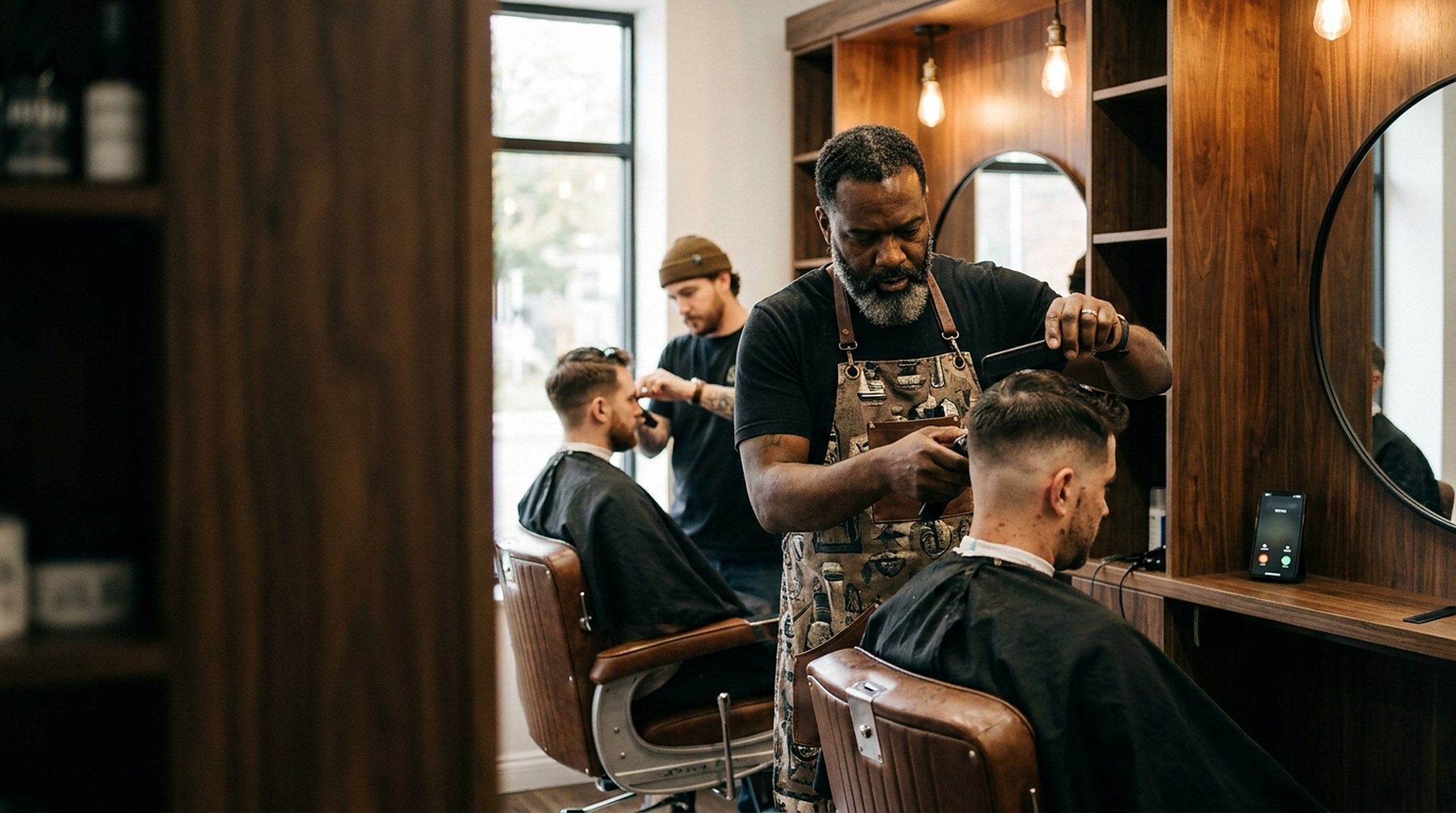
A barber mid-fade, clippers in hand, focused; a phone glowing on the station, ignored
For barbershops

Four chairs, clippers on. Regular calling. She's got it.

Two shops, six barbers, a Saturday wall of walk-ins. Stella picks up every call in the shop's own register, books into each barber's real chair at each shop, reminds, and fills the gap when someone doesn't show.

Union Barbers, this is Stella — what can I do for you?
The problem

The shop is loud, the phone is quiet, and the regular goes elsewhere.

  1. 01Every barber is halfway through a fade. The phone rings out. He books with the shop down the street.
  2. 02Saturday is a wall of walk-ins and a phone nobody can reach. Nobody knows what's free until they look up.
  3. 03Two shops, one Instagram, one number — and no one who knows both books at once.

You don't need a receptionist in each shop. You need someone who knows every chair in both, knows the regulars, and never asks a caller to hold.

A call, while your hands are busy

Saturday, 1:50. Dre is mid-fade. Marcus calls.

A regular, recognised by his number, greeted like a regular. No place name, no ceremony — straight to the chair.

Incoming call · Marcus · regular
S
Stella · Union Barbers
ringing
0:00
Illustrative conversation. She adapts to what people actually say.
SaturdayDowntown · Dre
What she does, all day

A front desk with the shop's own voice.

The universal six, and two that matter when half your book is regulars and the other half is walk-ins.

01

Answers every call, like a person would

No menus, no “press one”, no hold music, no disclaimer wall. Place, first name, how can I help — in one breath. Then she listens instead of interrogating. And she's there at 7:40 in the morning and 9 at night — when the parent thinks of it, not when you open.

“Good morning, this is Stella — how can I help?”
02

Books into the real book

She searches actual availability — who is where, doing what, for how long, in which chair or room — and never double-books. If she offers 2:20, 2:20 is free.

03

Reminds, and takes the reschedule call

Reminders go out ahead of time. When someone can't make it, she handles the flustered call with warmth and finds the next time without drama.

04

Fills the late cancellation

A cancelled four o'clock is the one slot you can't sell tomorrow. The moment it frees, she offers it — by text — to the people who've said they'd take short notice, who wanted earlier, or who owe a make-up. First yes takes it; nobody else hears about it.

“A 4:00 with Mr. Ellis just opened — want it?”
05

Tightens your day

A four o'clock cancels? She asks the five o'clock if they'd like to come earlier. Nobody is obliged, and it cascades — you finish at five, not six.

“The four's opened up — would you rather come at four?”
06

Learns each client, gently

Someone turns down a 9am; she stops leading with mornings for them. Preferences, never rules — and when she checks, she uses very few words.

“Mornings tough? I'll avoid them.”
07

Knows the regulars

Recognised number, no ceremony. She knows Marcus wants Dre, wants a cut and line-up, and never wants mornings. The more she knows you, the shorter the call.

“Hey Marcus, it's Stella. Looking for Dre?”
08

Two shops, one book

Barbers who float between locations have hours per shop, not one blob. If Dre's full downtown and Kev's free at Northside, she'll say so — and let the caller decide.
Last-minute cancellations

A cancellation is not a hole. It's an offer to the next person — the same morning.

She takes the cancellation the moment it comes, whatever the hour — nobody waits for the desk to open. Runway is money: the earlier she knows, the more people she can offer the slot to once your outbound hours open, and the likelier it fills. Your policy — notice period, deposit, fee — is yours; she states it plainly, applies it the same way every time, and stays kind about it.

S
Stella · Union Barbers
text messages
1:05
Illustrative. Your policy, her words.
2:30 · Cut & line-up · Drethe ledger
  1. 1:05Freed — Marcus cancels by text
  2. 1:05Policy applied, rebook offered — kindly
  3. 1:06Outbound hours open — offered to 4 people who asked for short notice
  4. 1:11Filled — Leo said yes; the rest hear “taken”
  5. ·Marcus · Mon 11:00 · confirmed 1:14
  • The freed slot goes to the people most likely to say yes: the short-notice list, the waitlist, make-ups owed, anyone who said “earlier if you can”.
  • First yes takes it. The others hear “taken” — never who, never why.
  • The make-up lands in a slot that would otherwise have gone empty; the freed slot earns today.
  • Your policy is applied the same way every time; the tone stays warm — especially to a parent with a sick child.
  • Outbound only inside your hours: she'll take a 7:40 text the instant it arrives and start offering the slot when your day opens — never before.
  • You see it on the panel — freed, offered, filled. Nothing to do.

Everyone on the short-notice list asked to be on it. Nobody is nagged; nobody hears another client's business.

And when it's your side

One sentence into the mic. She does the phoning.

Rain, a burst pipe, a birth, the autoclave, the hall double-booked — the whole block moves, and it's your call, not the client's. You say it once; she works out who's affected, offers each person the right alternative in their own words, waives the fee, logs the reason, and reports back. When it's an overrun rather than a closure she works by who can still act: the people who haven't left home yet get the call and the choice; the people already in the room get the honest ETA and a coffee; nobody further out is touched until the delay is still growing. Nobody hears why; nobody rings the desk.

Power's out downtown. Move this afternoon to Northside where you can, the rest to tomorrow, and text everyone.
Stella, twenty minutes later11 touched · 6 moved to Northside · 4 to tomorrow · 1 waiting · nobody rang the shop
Two shops, one number

Sooner, if you'll cross town.

Availability is per barber, per shop, per hour. When the caller's usual chair is booked out, Stella offers the other shop as a plain trade — never a bare time without the place.

  • Barbers' hours are per location; nobody 'belongs' to a shop.
  • The offer is always time and place; the caller chooses.
  • Regulars keep their barber by default; she offers a colleague only if the caller's open to it.
  • Walk-ins still work — a booking is a claim on a chair, and she can see what's genuinely free right now.
Marcus wants Dre, todaywho is where, when
DowntownDre · booked till MondayMon 11:00
NorthsideKev · chair freeToday 4:00

“Dre's slammed downtown till Monday. Kev's got four o'clock at Northside if that works — or I can hold Monday with Dre.”

A regular in the chair, cape on, laughing with the barber, warm afternoon light

The shop should sound like the shop. Not like a bank.

For your team

Nobody puts the clippers down to answer the phone.

A screen by the mirror shows who's next and what changed. A rep selling clipper oil never gets through. A regular who wants Dre gets Dre.

Now2:04Downtown
  • Chris cancelled 1:45 — offered it to Leo, who came early
  • Northside: Kev free 4:00–5:00
  • Two sales calls handled. Nothing for you.
“Block me out Tuesday afternoon, I've got the dentist.”
  • A panel, not an appan always-on screen at the desk that answers one question in five seconds: who's next, for whom, and has anything changed? Everyone sees their own day; the owner sees the floor. Something to read, not operate.
  • One button, your voicepress it and say “move Ana to four, and call Peter back for me.” That's the whole interface. She does the machinery behind the glass.
  • The shieldsales calls, scam calls, realtors — they never reach you and never appear anywhere. Real callers can ask to be put through; you still choose whether to pick up.
  • Only what can't waitat the desk, things land quietly on the panel. Out of the building, your phone only buzzes for the next hour or two.
  • Your whole inbound“tell Peter I'll be home at seven” in the same breath as the schedule. The cost of a personal call is the context switch, not the two minutes.
  • You are the bossyour team's hours guide what she offers on her own. A direct instruction — from you or from the stylist whose chair it is — is simply carried out, silently, and teaches her nothing about “normal”.

Two shops on one panel each — every barber sees their own day, and the owner sees both.

What she will never do

Warm is not the same as loose.

No menus

Not a phone tree

No “press one”. No “your call is important to us”. No recorded disclaimers before a human word. Warm, short, present — and honest if you ask what she is.

No inventing

Never makes things up

She offers what's in your catalogue and staff profiles. She won't crown a “best” anyone or promise an outcome. A time she offers is a time that's free.

No gossip

One client never hears about another

A moved client hears “we need to move your Tuesday — let me find you another time.” Never who, never why. And once moved kindly, they're not yo-yo'd back.

No pretending

Honest about what she is

She doesn't lead with it and doesn't apologise for it. Ask, and she'll tell you plainly: she's the assistant. She helps; that's what people remember.

Early access

Give Stella the shop.

Your barbers, your services and how long they really take, your shops and hours. She's set up by hand for the first shops, so we're taking a few at a time.

Stella is in early access with a small number of practices and salons. Tell us about your phone and we'll tell you plainly whether she fits — and when.

Thank you — you're on the list. A person will reply, not a sequence.
That didn't go through. Email hello@callitor.ai and we'll add you by hand.

No newsletter. No sales sequence. We reply when there's a real slot for you.